
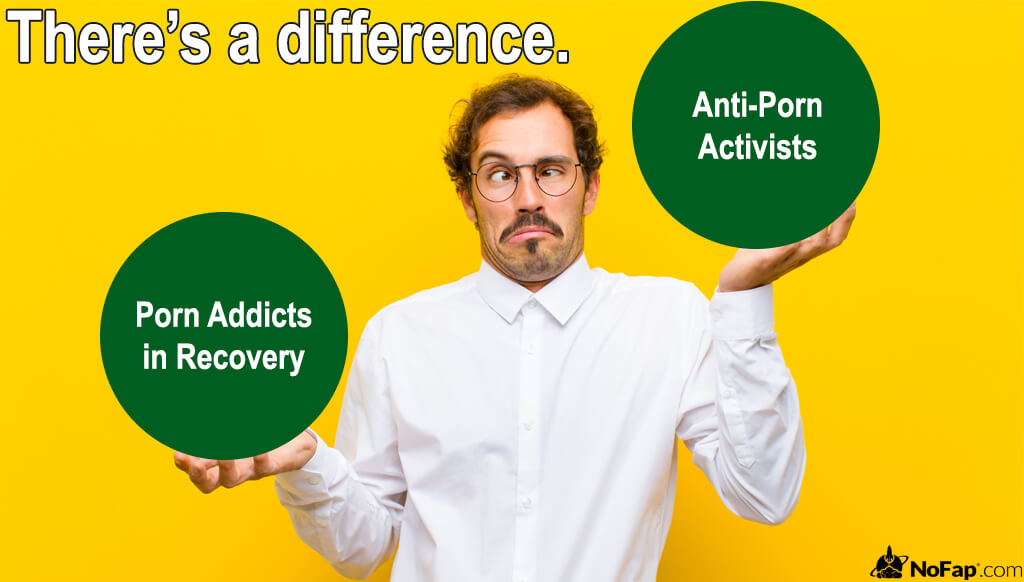
There has been a push by some organizations in the porn industry and its friends, along with some activist porn advocates, to dishonestly label anyone who raises concerns about excessive porn use as being “anti-porn.” While there are certainly some recovering porn addicts who also separately hold “anti-porn” beliefs, this is not a label that can accurately be applied universally to all, or even most, recovering porn addicts. Being against porn, and recovering from porn addiction, are entirely distinct concepts.
Recovery websites are about recovery. Duh.
We’re going through an unprecedented era in human history. For the first time in millions of years of evolution, many human beings are growing up and going through puberty with virtually unfettered access to digitized porn through the Internet. Many children and underage teens are using porn prior to their first date or first kiss. As the first generation of these digital natives reached adulthood, many realized that their excessive porn use resulted in unanticipated consequences. Many went online to seek support and answers, eventually congregating by the hundreds of thousands at NoFap, one of the first community-focused recovery websites in the field. By the thousands, young people reported an inability to stop using porn, negative effects in their lives and relationships, and even sexual dysfunction that they attributed to their porn overuse (after reducing or eliminating porn use, many reported that these symptoms were reduced or reversed). In addition to these anecdotes, numerous researchers have published studies which confirm that porn overuse can lead to negative effects and even that there can be brain changes consistent with the behavioral addiction model.
As for NoFap, it was founded by an atheist who didn’t experience shame, religious conflicts, or moral hesitations with using porn but experienced significant negative effects from using it for many hours per day since around 11-years-old. The creation of the website was inspired by undergraduate biology classes, the 2002 movie 40 Days and 40 Nights, and above all else, Rhodes personally struggling with severe porn addiction. While Rhodes researched and discussed the issue anonymously online for years, the forum wasn’t officially created until 2011, just as many other young people were realizing the effects that unlimited Internet porn use was having on their lives. NoFap’s membership grew exponentially. These people were generally not quitting porn due to any moral reasons, anti-porn views, or religious reasons – but they aspired to quit or limit their porn use to remove porn-induced side effects, improve their relationships, improve themselves, and, ultimately, live more fulfilling lives.
NoFap hosts just one of many secular support groups in the field – others include the PornFree subreddit and Your Brain Rebalanced. Social media websites contain hundreds more. Indeed, these recovery communities were a direct and natural reaction to the explosively emergent popularity of Internet porn – and have little to do with “anti-porn” initiatives of the past. Recovery is an issue of practicality, not an issue pertaining to moral judgment. Recovery is not a cultural war, but rather a personal war in an addicts’ life between destructive behavior and desire for positive change. These recovery initiatives have nothing to do with religion, but rather a giant community of people from a wide variety of backgrounds and beliefs coming together to overcome problematic behavior.
While some (often religiously-affiliated) support groups also hold “anti-porn” views (and sometimes, people believe that holding “anti-porn” views are beneficial for their recoveries), many porn addiction recovery initiatives are not “anti-porn.” NoFap is a recovery website for people who struggle with porn overuse, porn addiction, and compulsive sexual behavior. NoFap can be distilled down to two words: support group. Many people consider NoFap akin to an online and non-religious version of Alcoholics Anonymous – although for excessive porn use, rather than excessive alcohol consumption. It’s just as ridiculous to label a porn addiction recovery support group “anti-porn activists” as it is to label Alcoholics Anonymous as “anti-alcohol activists.”
NoFap is a recovery website, not an anti-porn website.
While we are aware of a number of anti-porn personalities and respect their perspectives, organizationally, NoFap is a recovery website that does not align with the “anti-porn” label. NoFap does not argue that porn should be banned or otherwise aim to enact legislation to limit the creation or consumption of porn. NoFap does not argue that all forms of porn are universally immoral to partake in, or even say that using porn is always bad for all people in all circumstances. NoFap does not engage in sweeping statements or “one size fits all” pieces of advice such as arguing that nobody, regardless of who they are, should ever use porn for any reason.
In a sense, we feel that porn can be considered the sexual equivalent of junk food. Some people can incorporate junk food into their diets and enjoy it with limited adverse effects, while others overeat and fall into obesity. Even if you’re somebody who considers donuts or fast food to be generally “unhealthy” or “bad” to eat, that doesn’t mean that you’re an “anti-donut” or “anti-fast food” activist. By that standard, the vast majority of the world population would fall under those classifications. Even though most people know that junk food is “unhealthy” and “bad” compared to other foods, most people continue to eat it in moderation. It’s certainly possible to recognize that something has risks associated with its use, without being against the existence of the thing, or thinking that nobody should ever engage with the thing.
NoFap goes further than this and has consistently argued against combating porn addiction with censorship. For example, back in 2014 Maclean’s Magazine published that founder Alexander Rhodes described himself as “a bit of an Internet-freedom zealot” who “thinks the dangerous effects of porn are best dealt with in sex-ed class and not through government regulation.” In 2019, Rhodes made it clear on CNN: “I think it’s everybody’s personal choice whether to consume it or not. It’s like cigarettes, in my opinion. I think that the more of it you use, the more at risk you are for addiction and the more at risk you are of negative side effects.” Indeed, some people are able to enjoy occasional tobacco with limited negative effects. In a February 2020 tweet, Rhodes tweeted “I’m not your stereotypical ‘religious conservative anti-porn zealot’ that the porn industry and its friends are trying to label me as because they have no good arguments against what I have to say.” NoFap isn’t anti-porn, it’s anti-porn addiction and aims to provide a supportive, shame-free, safe atmosphere for people recovering from it.
While some users of recovery websites might express “anti-porn” views, survey data indicates that the majority of NoFap’s users do not see masturbation or pornography as universally immoral or unhealthy activities for everyone. Certainly, if you observed a gambling addiction recovery meeting, you would hear some quips and rhetoric about gambling being “unhealthy” or “bad,” but that certainly doesn’t mean these recovering gambling addicts consider themselves to be “anti-gambling” for people other than themselves. We don’t go around saying that everybody in the world needs to quit porn. Some people who struggle with porn overuse deescalate their porn use, consciously setting limitations on how often they use or how much time they spend on porn. However, for porn addicts, using porn in moderation is generally challenging to impossible (quickly escalating back to pathological use) – so for them, quitting porn entirely for the foreseeable future is often advisable.
If you’re scrutinizing the comments shared in a peer support setting, you are bound to see some rhetoric against the behavior or substance that the group members are working to distance themselves from. Not only is it inaccurate, accusing gambling addicts of having some sort of secret “anti-gambling” moral or religious agenda can even be harmful to their recoveries because it can easily be interpreted as attempting to invalidate their life experiences and adversity. Quitting an addiction is hard enough without being accused of being a zealot or fanatic. Nobody seems to accuse recovering gambling addicts of having dishonest or illegitimate motives for wanting to quit gambling. Recovering porn addicts want the same societal acknowledgment and respect of their very-real struggles.
Some members of gambling addiction support groups might indeed believe that nobody (including non-addicts over the age of 18) should ever gamble for any reason. Certainly some users of NoFap, albeit a minority, consider themselves to be both in recovery and “anti-porn.” An even smaller segment of users quit or reduce their porn use for personal reasons outside of recovery. However, the World Health Organization’s recent classification of compulsive sexual behavior disorder, which some experts believe is an appropriate temporary diagnosis for porn addicts, specifically excludes diagnosis due to “distress that is entirely related to moral judgments and disapproval about sexual impulses, urges, or behaviours.” Needless to say, the individual views of users, especially a minority of users, do not reflect the views of an organization, nor does an organization’s views accurately reflect the views of every one of its users. Following such logic, Facebook would be personally responsible and in agreement with every comment ever made on their platform by their billions of users. In general, we have a “live and let live” attitude. NoFap is proud to host an incredibly diverse community consisting of people with different views on porn, of different backgrounds and belief systems, religious beliefs (and non-belief), sexual orientations and identities, nationalities, ethnicities, ages, and countless other characteristics. The one thing that unites the recovery community is the pursuit of better lives and relationships.
So why did I hear online that recovery advocates are anti-porn?
For people who unwittingly made assumptions or are just mistaken – we don’t have any hard feelings! We want to have open conversations about porn addiction, which is exactly why we’re putting out content like this to clarify our stances. However, not all of this is innocuous. There has been an effort by some entities, some of them with ties to the porn industry, to seemingly deliberately mislabel people in recovery, or recovery advocates, as “anti-porn.”
While this is just a guess, we suspect that they engage in strawman-style logical fallacies because they have not been able to formulate convincing factual responses to our actual, science- and evidence-supported reasonable views. So they put in our mouths an entire set of fictitious sentiments (things that we’ve never said) that they can then pretend to argue against. In reality, our views are quite rational – and as a result, some entities are on a mission to falsely make recovery advocates appear to be irrational. It’s an attempt to obfuscate the emergence of problems associated with porn overuse in the digital age – by conflating them with anti-porn efforts of past decades (before the Internet existed).
Beyond recovery, it seems that just about any critical, fact-based discussion about pornography is being labeled as “anti-porn” by some in the porn industry. For example, a porn industry publication and lobbying group both published material referring to Kate Isaacs as an “anti-porn crusader.” Kate Isaacs is the founder of Not Your Porn, which she describes as an initiative to “make hosting revenge porn on porn websites illegal.” We had a chat with Isaacs and she largely agreed that the disinformation is intended to distract from the real issues.
Kate Isaacs shared that she’s “not anti-porn as a concept, and never have been.” She believes that “pornographic imagery for sexual pleasure” is “totally healthy, and there should be no guilt around that.” Isaacs also reports that she has been working with sex workers in the UK to increase their rights within the industry, including advocating against large porn companies who steal content (engaging in copyright infringement) from independent performers. Isaacs describes herself as a liberal and an atheist. Indeed, many people who do identify with “anti-porn,” are, in reality, anti-commercialized porn due to the porn industry’s often-reported questionable treatment of its performers. While Kate Isaacs might be accurately described as “anti-non-consensual-porn,” the reality doesn’t match the “anti-porn crusader” false picture that the pornography industry has attempted to paint of her.
Let’s be clear: you don’t need to be “anti-porn” to think that:
- Porn overuse can lead to negative effects.
- Porn addiction is real and fits within the behavioral addiction model.
- Children and underage teenagers shouldn’t use porn.
- People should be aware of the potential pitfalls of digital porn use, particularly the risk of overuse and addiction.
- Support groups, therapy, and other help should be available for those who struggle with porn addiction or overuse.
- Porn should feature consenting adults, not sexual exploitation.
- Many within the porn industry have a poor track record for their treatment of performers.
- Porn companies can do a better job of enacting age verification measures to prevent underage viewers.
- Porn companies can do a better job of verifying the ages and consent of people who appear in porn that they host.
Let’s encourage people to use concise language to avoid miscommunication.
Whenever people hear about recovery initiatives from some (not all!) within the porn industry, its friends, and activist porn advocates, they often do not get an accurate view of what recovery is all about. Ultimately, everybody is harmed whenever people engage in strawman-style smears or otherwise spread misinformation. If there is going to be an open and productive conversation about excessive porn use, there has to be mutual, good-faith respect with a focus on facts, science, and truth. We aren’t trying to disparage people who hold pro- or anti-porn views. We simply just think that as an apolitical, non-religious, shame-free recovery support website, it is not our place to take moral stances for, or against, the general use of pornography.
Moving forward, we encourage everyone to use concise language while describing the views of people they disagree with, rather than resorting to misrepresenting their actual views. Instead of assuming people’s what people believe, consider asking them. Seek out whether or not they identify with the “anti-porn” label, and if they do, consider asking what “anti-porn” means to them. Ditch the phrases anti-porn zealot, crusader, activist, and even “anti-porn” itself entirely – when referring to people in recovery, recovery advocates, and everyday people who hold common-sense views about porn. When it comes to “anti-porn” and “porn addiction is real” views – people can identify with one, the other, or both, but they are not the same thing. We believe that recovery is a unifying issue that everyone can get behind, whether they are anti-porn, pro-porn, or neutral on the subject.